About Welding Machines for Tents, Shelters & Structures
Tent welding machines are industrial systems that use controlled heat and pressure to fuse thermoplastic-coated fabrics into sealed, waterproof seams — replacing sewing for critical structural joints in event tents, emergency shelters, clearspan buildings, and large fabric structures.
If you manufacture tents, shelters, or fabric structures and you're evaluating equipment, this guide covers everything you need to make an informed decision: how these machines work, which welding method suits your material, which seam types matter for your product, and how to match a machine to your production scale. Miller Weldmaster has designed and manufactured fabric welding equipment for the tent and structure industry since 1974, and the guidance here reflects that application experience.
Unlike traditional metal welding used in construction, fabric welding uses controlled heat and pressure to fuse thermoplastic materials like PVC and vinyl. The result is a seamless bond that is stronger, more consistent, and more resistant to environmental stress than sewn alternatives. Different welding methods and equipment can significantly affect the performance and durability of welded seams in tents and shelters.
This equipment is built for tent manufacturers, military shelter producers, event structure companies, and industrial fabricators looking to improve production efficiency and product quality. In this guide, you’ll learn how to choose the right welding process, machine type, and level of automation—while understanding how each impacts seam strength, speed, consistency, labor requirements, and scalability.
Belangrijkste opmerkingen
- Tent welding machines replace sewing with heat-fused seams that are inherently waterproof — no needle holes means no built-in leak points.
- Hot air welding is the most versatile method for tent production, handling curved seams, reinforcement zones, and PVC-coated polyester fabrics across a wide range of product types.
- Hot wedge welding delivers higher throughput on long, straight panel seams and is the preferred method for automated tent production workflows.
- Keder — the reinforced piping strip welded to tent panel edges — is a critical structural component for clearspan and tension tent frames, and is welded on a keder welding machine or a multi-seam tent welder.
Choosing the Right Machine Starts with Your Application
Machine selection depends on your material type, seam geometry, production volume, and finishing requirements, including keder, hems, overlaps, automated feeding, and other custom production needs.
What Is a Tent Welding Machine?
A tent welding machine is industrial equipment that joins thermoplastic-coated fabrics by heating the coating until it softens, then pressing the layers together so they bond as the material cools. The result is a continuous, sealed seam that becomes part of the fabric itself — not a separate thread running through it. These machines are used by tent manufacturers, shelter fabricators, and large fabric structure producers across the event, military, agricultural, and commercial construction sectors.
The core principle is straightforward: thermoplastic-coated fabrics — PVC-coated polyester, polyethylene film, TPU-coated textiles — can be fused together with the right combination of heat, pressure, and speed. The machine controls all three variables precisely, which is what separates industrial welding equipment from handheld heat tools. That precision is what produces consistent, production-grade seams at volume.
How Tent Welding Machines Work
Heat is delivered to the fabric surface just before two or more layers meet at a set of compression rollers. Depending on the welding method, the heat source is either a stream of precisely controlled hot air directed through a nozzle, a heated metal wedge positioned between the fabric layers, or electromagnetic energy that heats the material from the inside. In all three cases, the thermoplastic coating softens, the rollers apply compression, and the layers bond as the material exits the weld zone and cools.
Temperature, speed, and pressure are set by the machine — not estimated by an operator. That consistency is the production advantage. Every seam across a full production run holds the same weld quality, which directly affects product warranty performance, return rates, and your ability to scale output without scaling defects.
Why Waterproof Seams Require Welding, Not Sewing
Every needle puncture in a sewn seam is a potential leak point. In a tent, those punctures run across every panel join, hem, and attachment point. Even with seam tape applied as a secondary step, sewn seams introduce mechanical stress concentrations at each perforation — exactly where weather, wind load, and repeated assembly cycles create fatigue over time.
Welded seams contain no punctures. The bond is molecular — the coating materials merge at the seam zone, creating one continuous, sealed joint. Welding also creates strong seams needed for durable, water-tight tent and shelter assemblies that face repeated assembly, disassembly, and weather exposure. There is no separate material bridging the gap, no adhesive that can delaminate, and no thread that can fray, wick moisture, or degrade under UV exposure. For manufacturers producing event tents, emergency shelters, or any structure where seam failure has consequences, welding is not an upgrade — it is the correct production method.
Welding vs. Sewing for Tents: A Quick Comparison
Here is how welded and sewn tent seams compare. Our guide to heat seam welding for tents covers waterproof seam setup, reinforcement and quality checks in detail.
| Criteria | Lassen | Naaien |
|---|---|---|
| Waterdicht maken | Inherently sealed — no holes in the fabric | Requires seam tape or sealant as a secondary step |
| Structural strength | Continuous bond across the full seam width | Concentrates stress at each needle perforation |
| Production consistency | Machine-controlled temperature, speed, and pressure — every seam identical | Operator-dependent; variability increases with volume |
| Productiesnelheid | Continuous seams at up to 30 m/min (100 ft/min) on the T300 Flex and T600 Shelter, depending on material and seam | Slower; limited by operator and thread management |
| Operator skill required | Low-to-moderate — machine controls critical variables | High — seam quality depends on operator technique |
| UV and weather durability | No thread to fray or degrade; bond is part of the fabric | Thread degrades under UV, moisture, and flex cycling |
| Materiaalcompatibiliteit | Thermoplastic-coated fabrics (PVC, PE, TPU, PP) | Broader range including non-thermoplastic materials |
| Repairability | Field repairs possible with portable welding tools | Field repairs with needle and thread or adhesive patch |
Welding Methods for Tent and Structure Fabric
Choosing the Right Approach
Tent and structure manufacturers use three primary welding methods: hot air, hot wedge, and RF/high-frequency. Each method delivers heat differently, which means each has distinct strengths depending on material type, seam geometry, and production volume. For manufacturers working with polar thermoplastics, understanding how high-frequency welding works in detail can clarify when RF is the right choice. Choosing the right method before selecting a machine is the most important decision in the equipment evaluation process.
Hot Air Welding — Best for Curved Seams and PVC-Coated Fabrics
Hot air welding directs a precisely controlled stream of heated air through a nozzle onto the fabric surface just before compression rollers bond the layers. The air temperature typically ranges from about 370°C to 730°C (700°F to 1,350°F), depending on material and seam requirements. The operator — or the machine's automated feed system — controls material speed, which together with temperature and roller pressure determines weld quality.
Hot air is the most widely used welding method for tent and structure production because of its versatility. It handles PVC-coated polyester, TPU-coated fabrics, polyethylene, and polypropylene, and it adapts to curved seams, angled seam geometries, and varying material thicknesses within the same production run. That flexibility makes it the default method for manufacturers producing multiple tent shapes or working with custom structural geometries.
On Miller Weldmaster machines, hot air welding is available on the T300 Flex, T600 Shelter, T600 Flex and other platform models. These machines also support hot wedge as an alternative or simultaneous option, giving manufacturers the ability to choose the right method for each seam type on the same machine.
Hot Wedge Welding — Best for Long Straight Seams and High-Throughput Production
Hot wedge welding positions a heated metal wedge precisely at the weld point between two fabric layers. Heat transfers through direct contact, which produces highly consistent thermal input across the full seam width. As the fabric layers pass over and under the wedge and into the compression rollers, the heated zones bond under pressure.
The main advantage of hot wedge over hot air is throughput consistency on long, straight seams. Because heat transfer is direct rather than airstream-based, hot wedge is less affected by ambient temperature variation and delivers more uniform weld energy at higher production speeds. For a manufacturer running large clearspan building panels or long event tent sidewall seams, hot wedge welding is typically the faster and more consistent choice.
Hot wedge is effective on PVC-coated polyester, HDPE, LDPE, and heavier coated fabrics. It is the preferred method for automated tent production lines where consistent seam quality at volume is the primary requirement. The T600 Shelter supports both hot air and hot wedge welding with dual arm configuration, giving manufacturers the option to switch between methods or run both simultaneously.
RF / High-Frequency Welding — Best for Precision Cosmetic Seams
RF welding (also called high-frequency or HF welding) applies electromagnetic energy to the fabric, which heats polar thermoplastic materials from the inside out rather than from the surface. This internal heating produces very consistent weld energy distribution and is useful for applications where cosmetic seam finish and dimensional precision are critical.
For tent manufacturers, RF welding is relevant for specific components — certain reinforcement zones, cosmetic-grade seams in visible tent panels, and applications where surface marking from a hot wedge or nozzle is unacceptable. It is not a general-purpose tent seam method. RF welding only works on polar thermoplastic materials, which means it is not compatible with polyethylene, polypropylene, or non-woven polyester fabrics.
RF welding also carries a higher equipment capital cost than hot air or hot wedge systems. For most tent and structure manufacturers, hot air or hot wedge welding covers the full production requirement. RF welding enters the picture when a specific component or customer specification requires it.
What Fabrics Can Tent Welding Machines Weld?
Tent welding machines are designed for thermoplastic-coated fabrics — materials where the coating softens under heat and bonds under pressure. The base fabric (polyester, nylon, woven polyethylene) provides structural integrity; the thermoplastic coating (PVC, PE, TPU, PP) is what actually welds. If a fabric does not have a thermoplastic-compatible coating, it cannot be joined by heat welding.
PVC-Coated Polyester — The Dominant Tent Fabric
PVC-coated polyester is the most widely used material in commercial tent and structure manufacturing. The polyester base provides tensile strength and dimensional stability; the PVC coating provides weather resistance, UV protection, and the thermoplastic surface required for welding. Manufacturers often rely on PVC laminated fabric for tent welding because it welds cleanly with both hot air and hot wedge methods, accepts a wide range of coating weights (from lightweight event tent fabric to heavy-duty clearspan panel material), and is the material most Miller Weldmaster tent machines are optimized for.
Polyethylene (PE) — For Lightweight Shelters and Agricultural Covers
Polyethylene fabrics and films are used in greenhouse panels, agricultural covers, and lightweight emergency shelters. PE is weldable with hot air and hot wedge, but its lower surface energy compared to PVC means bonding behavior is different. Hot wedge welding is often preferred for consistent bond strength on heavier PE materials because direct heat contact produces more reliable activation at PE's bonding temperature range.
Polyurethane / TPU — For Technical and High-Performance Structures
Polyurethane-coated fabrics and TPU-based textiles are used in inflatable structures, air-supported buildings, and specialty shelters where performance requirements go beyond standard weather protection. Hot air welding works well with TPU-coated fabrics. TPU welding parameters differ from PVC — temperature and speed settings need to be adjusted for the specific TPU coating being used.
Polypropylene and Non-Woven Fabrics
Polypropylene fabrics are weldable with hot air welding, but PP needs careful temperature and speed settings to avoid material damage. Non-woven polyester and polypropylene fabrics are usually welded with hot air rather than hot wedge, because direct contact with a heated wedge can displace or compress the fiber structure before the weld forms. If your product uses non-woven material in any structural component, confirm the appropriate welding technology with Miller Weldmaster's application team before selecting equipment.
Seam Types for Tents and Structures
Why Seam Type Matters
The main tent seam types are overlap seams, hems, hems with pocket, hems with rope and keder. The seam type your product requires determines which machine you need. Not all tent welding machines produce all seam types, and selecting a machine without mapping its seam capability to your product requirements is the most common source of equipment-fit problems in this industry. The seam types most commonly required in tent and structure manufacturing are covered below.
Overlappende naad
The overlap seam is the foundational tent construction seam. Two fabric panels overlap by a set width and are welded through both layers, creating a continuous bond across the full overlap zone. It is the primary seam used for sidewall panel joins, roof panel connections, and most structural fabric-to-fabric joins in tent manufacturing. Nearly every Miller Weldmaster tent machine produces this seam type.
Hem and Hem with Pocket
A hem seam folds the fabric edge back on itself and welds the fold to create a clean, reinforced finished edge. The pocket variant opens the folded hem into a channel — a tube of welded fabric — that a structural pole, rope, or tensioning element can slide through. Hem-with-pocket seams are used wherever a tent panel needs to attach to or wrap around a structural element without the use of grommets or mechanical fasteners along the full panel edge.
Zoom met touw
Hem-with-rope seams insert a rope or bead into the hem channel during the welding pass, locking it in place as the hem closes around it. The resulting edge is a fabric-encased rope that distributes anchoring force along the full tent perimeter rather than concentrating it at discrete attachment points. This seam type is standard on event tents and commercial shelters where perimeter anchoring to stakes, weights, or frames is required.
Keder
Keder is a reinforced piping strip — a cord or bead wrapped in a coated fabric flap — that is welded to the edge of a tent panel. The keder's bead slides into a track extrusion on the tent frame, holding the panel under tension while allowing it to be installed and removed without mechanical fasteners along the panel edge. In clearspan buildings, tension tents, and architectural fabric structures, keder is not an accessory — it is the primary mechanism that connects the fabric to the frame.
High-volume keder production calls for a dedicated keder welding machine. The T300 Extreme Keder from Miller Weldmaster is a complete automated system built for high-speed single or double-sided keder production. It is designed to run keder at maximum production speeds — making rolls of keder continuously for manufacturers who need high-volume keder output for clearspan building programs or large tent fleets.
The T600 Shelter can also produce keder seams as part of its multi-seam capability, making it useful for manufacturers who need keder production but also need the flexibility to run other seam types on the same machine.
Where Tent Welding Machines Are Used
Tent welding machines are used to make event and party tents, clearspan buildings and industrial shelters, military and emergency shelters, and greenhouses and agricultural structures. Each has different material requirements, seam priorities, and production scale expectations.
Event and Party Tents
Event tent manufacturers produce sidewall panels, roof panels, and keder edges in high volume across a range of tent sizes and configurations. The primary production tasks are overlap seam welding on large panels and keder attachment along tent edges for frame connection. Standard rectangular tents, pagoda tents, and hexadome designs all use the same core seam types, which means a single T300 or T600 setup can cover the full product range.
Clearspan Buildings and Industrial Shelters
Clearspan fabric buildings use heavy PVC-coated polyester panels attached to aluminum extrusion frames via keder. Panel seams need to be consistent and strong — these are permanent or semi-permanent structures that face real wind and weather loads. For manufacturers scaling output, automated welding solutions for tents, structures, and shelters help relieve production bottlenecks, and high-volume keder production is typically the production bottleneck in clearspan manufacturing, which is why the T300 Extreme Keder's dedicated, high-speed keder capability is particularly relevant for this sector.
Military and Emergency Shelters
Military shelter manufacturing and emergency preparedness stockpile programs require consistent seam quality across high-volume production runs. Welded seams are waterproof without the secondary sealing steps that sewn seams need. Automated welding systems reduce operator variability and maintain consistent seam quality across long production runs — critical when producing thousands of shelter units for stockpile programs.
Greenhouses and Agricultural Structures
Greenhouse panel and agricultural cover welding typically involves polyethylene film or coated PE fabric. These materials need clean overlap and hem seams along panel joins and perimeters. Hot air welding is well-suited for the lighter PE films used in greenhouse applications, while hot wedge welding is preferred for heavier PE fabric panels in agricultural covers and more durable greenhouse structures. For operations looking to expand capacity cost-effectively, Miller Weldmaster's certified used fabric welding machines can be a practical way to add this capability.
Miller Weldmaster Tent and Structure Welding Machines
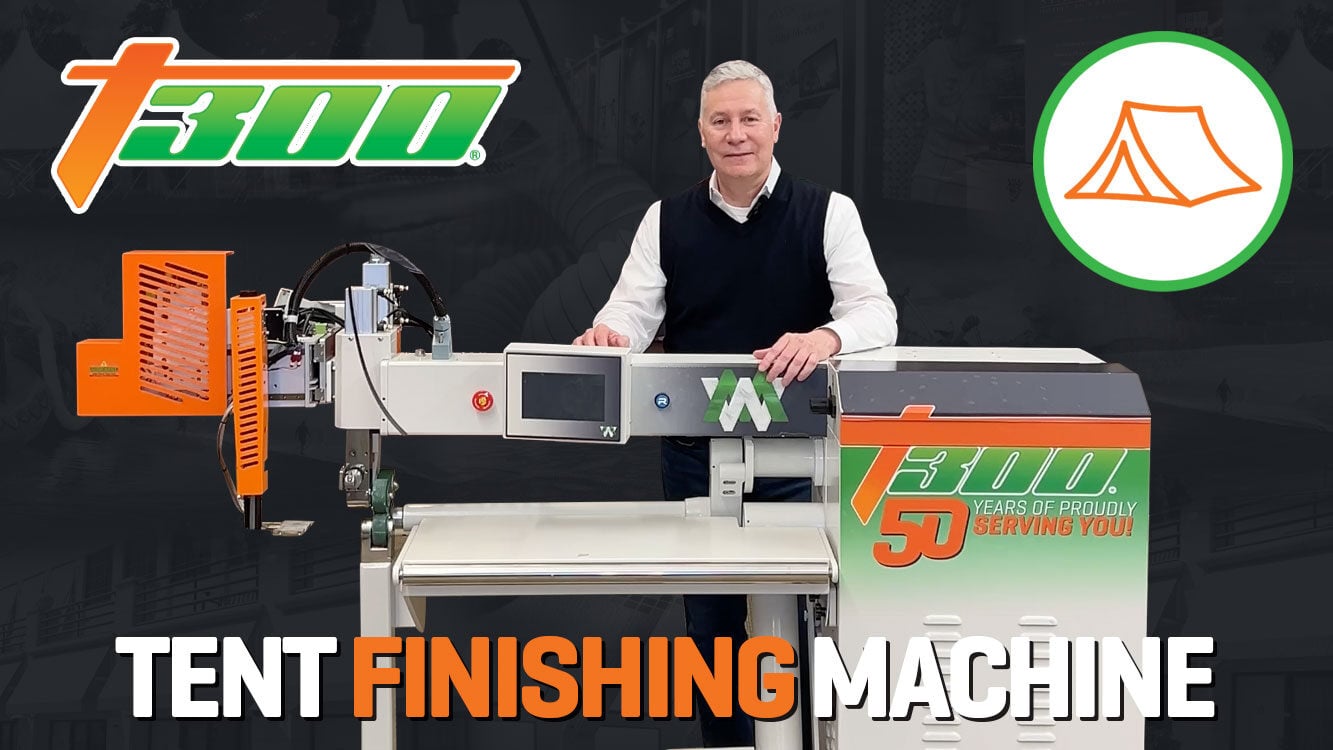
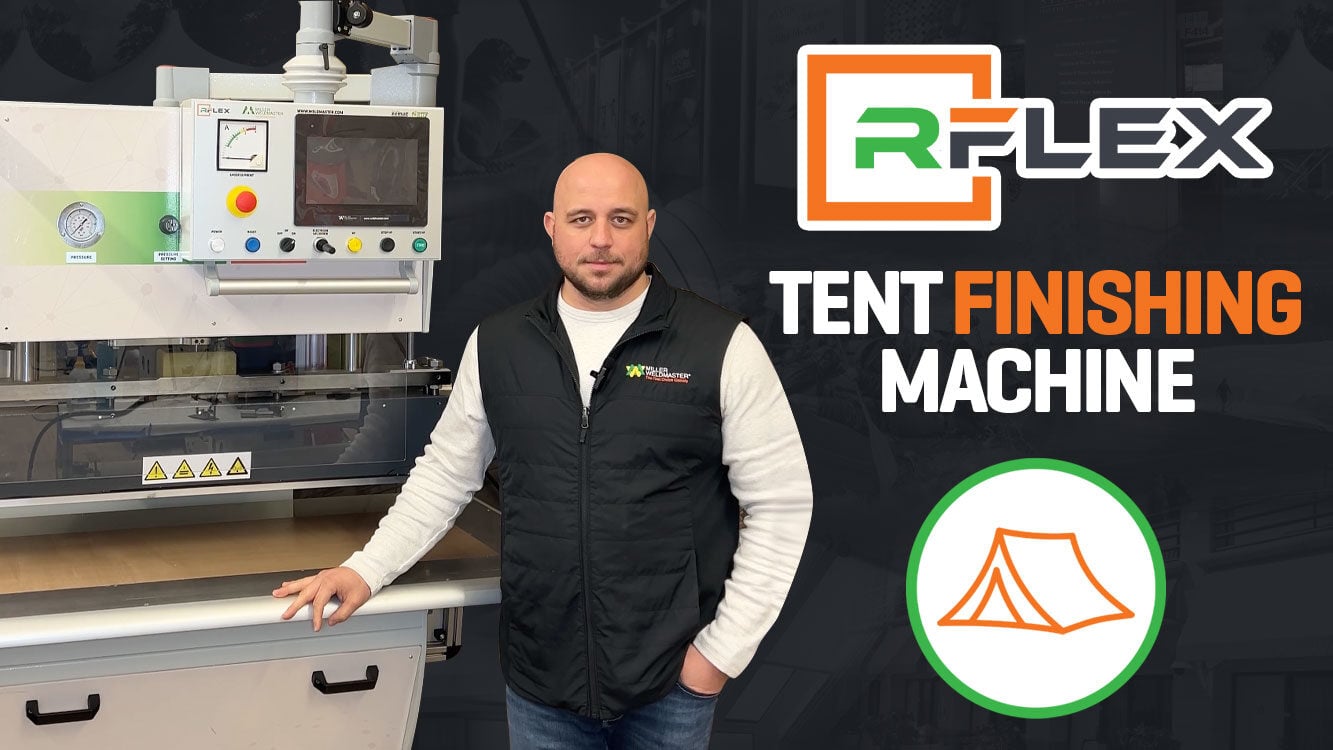
Miller Weldmaster's main tent and structure welding machines are the T300 Flex, T600 Shelter, T300 Extreme Keder and Triad Extreme Shelter, plus the automated Moduline Tent Welder and Moduline Welding Keder for production lines. Tent makers also use the T600 Flex, the M100 Single Panel keder panel welder and the RFlex for RF-welded parts. See every tent machine in the machine finder.
| Machine | Productieschaal | Seam Types | Het beste voor |
|---|---|---|---|
| T300 Flex | Small to mid-volume | Overlap, hem, hem with pocket, hem with rope, keder — hot air and hot wedge | Event tents, awnings, banners, inflatable structures, multi-product shops needing one flexible machine |
| T600 Shelter | Mid to high-volume | Hem, hem with pocket, hem with rope, keder, overlap, extrusion beading — hot air and hot wedge dual capability | Large event tents, clearspan panels, gymnasium curtains, greenhouses, pergolas — the primary heavy-duty tent machine |
| T300 Extreme Keder | High-volume keder specialist | Keder (single and double-sided, automated) | Clearspan building manufacturers and tent producers requiring high-speed dedicated keder production |
| Triad Extreme Shelter | Small to mid-volume; portable | Hem, hem with pocket, hem with rope, overlap, extrusion beading — hot wedge | Shelter and structure makers who want a compact hot wedge welder on a tabletop track or as a stationary welder |
| Moduline systems (automated) | High-volume / production line | Multi-roll overlaps, hems, keder, webbing and grommets in one pass, cut to length — hot air | Facilities running high-volume continuous production of tent panels with minimal operator intervention |
How to Choose a Tent Welding Machine — A Buyer's Guide
To choose a tent welding machine, match it to your fabric, every seam type your product needs, your production volume, the level of automation you want, and the installation, training and support behind it. Choosing a tent welding machine is a capital equipment decision that will define your production capability for years. Whether you produce standard structures or custom tents for unique applications, the five steps below give you the evaluation framework to make that decision based on your actual production requirements rather than machine spec sheets alone.
Step 1 — Define Your Material and Fabric Weight
Identify your fabric's coating type (PVC, PE, TPU, PP), base fabric, and weight. These factors determine the heat, pressure, and speed settings needed for welding. Knowing this helps narrow down suitable machine options that match your material requirements.
Step 2 — Identify the Seam Types Your Product Requires
Before evaluating any machine, document every seam type your product uses, such as overlap panel joins, hem edges, hem-with-pocket channels, hem-with-rope perimeters, and keder attachment. Ensure the selected machine covers all required seam types or consider using multiple machines to meet your needs. This step is crucial to avoid equipment-fit issues and ensure efficient production.
Step 3 — Match Machine to Production Scale
Production scale determines the right machine: small or custom shops typically use the versatile T300 Flex or the portable Triad Extreme Shelter, mid- to high-volume production often relies on the T600 Shelter, and high-volume automated systems with multi-roll feeding are suited for large-scale tent panel manufacturing.
Step 4 — Evaluate Automation Level and Operator Requirements
Semi-automated machines require an operator to feed and guide material, while fully automated systems handle feeding, alignment, and multi-seam production with minimal input. Choose the level of automation based on your labor availability, desired quality consistency, and production volume. Fully automated machines increase efficiency and reduce operator error, making them ideal for high-volume production. Semi-automated machines offer more control and flexibility for smaller runs or varied products.
Step 5 — Plan for Installation, Training, and Lifecycle Support
A tent welding machine is a long-term investment that includes not only the equipment but also installation, operator training, and ongoing service support. These elements ensure consistent performance and help lower the cost-per-seam over the machine's lifespan. Proper training and support maximize uptime and seam quality. This comprehensive approach protects your investment and production efficiency.
Why Tent and Structure Manufacturers Choose Miller Weldmaster
Manufacturers choosing a fabric welding machine are making a capital investment that will anchor their production capability for years. The machine quality, application fit, and support infrastructure behind that machine all affect the return on that investment. Here is what tent and structure manufacturers consistently identify as the reasons they choose Miller Weldmaster.
Fabric Welding Experience Since 1974
Miller Weldmaster has been designing and manufacturing fabric welding equipment for the tent and structure industry since 1974. That tenure is application knowledge accumulated across many production environments, material types, and seam challenges. When an application engineer evaluates your production requirements before recommending equipment, the guidance reflects that history, not a spec sheet.
Application-First Engineering — Not Off-the-Shelf Equipment
Miller Weldmaster's approach is to evaluate the customer's specific material, seam geometry, and production requirements before recommending equipment. That means the machine configuration you receive is matched to what you actually produce — not a default configuration shipped from inventory. For manufacturers with unusual material combinations, custom structure geometries, or specific automation requirements, this process-first approach is the difference between equipment that works in production and equipment that works in a demo.
Installation, Training, and Lifecycle Support
Every Miller Weldmaster machine installation is handled by a certified field service engineer who comes to your facility, installs the equipment, and trains your team on operation and maintenance. Operator training covers machine operation, maintenance schedules, and how to produce your specific products — not a generic tutorial. Genuine spare parts availability and service support are maintained throughout the machine's lifecycle, which is designed for decades of use.
The long machine lifecycle translates into a cost-per-seam that decreases significantly over time. A machine that runs reliably for decades with proper maintenance amortizes its capital cost across a large volume of production — and the consistency it delivers in that time protects your product quality and your customer relationships.
See how Miller Weldmaster tent welding machines perform in real production environments.