A corrugated box machine turns corrugated board into custom-sized boxes by cutting, creasing, slotting, and preparing material for finished packaging. Choosing the right machine is less about finding the fastest option and more about understanding how your operation runs—whether you need flexibility for frequent, smaller batches or consistent throughput for larger production demands.
The right solution should match your box sizes, order patterns, material requirements, available space, and plans for future growth. Miller Weldmaster's box making machine lineup offers options across this production spectrum, helping manufacturers bring more of their packaging process in-house.
Belangrijkste opmerkingen
- The right corrugated box machine depends on order variability and changeover frequency—not simply maximum production speed.
- Short-run operations benefit from fast setup and the ability to quickly switch between box sizes and styles.
- Higher-volume operations may require continuous feeding and greater capacity for sustained production.
- Many manufacturers fall somewhere between short-run and high-volume production and need a machine capable of handling a mix of requirements.
- Board thickness, box styles, available floor space, and future production needs should all be considered before choosing a machine.
What Does a Corrugated Box Machine Actually Do?
A corrugated box machine is equipment designed to convert sheets, continuous corrugated board, or large rolls of kraft paper into boxes of specific sizes and styles, including strong shipping cartons. Depending on the machine and configuration, the process can include cutting, creasing, slotting, trimming, and other steps needed to prepare corrugated material for finished boxes.
Instead of purchasing and storing large quantities of pre-made boxes, manufacturers can produce the sizes they need when they need them. This can be particularly valuable for businesses that manufacture products of varying dimensions or regularly fulfill orders requiring different packaging configurations.
On-demand box production can also simplify inventory. Rather than dedicating warehouse space to numerous box sizes, companies can keep corrugated material on hand and manufacture boxes according to current production requirements, which can reduce warehouse space needs by 60-80% by eliminating pre-made box storage and cut inventory carrying costs by 60-80%, improving cash flow.
The result is greater control over packaging production and the ability to adapt as order patterns, products, and customer requirements change.
Short-Run vs. High-Volume Production: Understanding the Spectrum
Packaging operations rarely fit perfectly into either "short-run" or "high-volume" categories. A company might manufacture hundreds of identical boxes for one product while needing only a few dozen custom boxes for another. Seasonal demand can further change those requirements throughout the year.
For that reason, choosing a corrugated box making machine should start with understanding where your operation falls on a production spectrum.
At one end are highly variable environments where box dimensions and styles change frequently. Speed is still important, but fast setup and flexibility may have a greater impact on overall productivity.
At the other end are operations producing larger quantities of boxes with fewer changes. These applications can place greater importance on material feeding, sustained output, automation, and the ability to process demanding corrugated board.
Between those extremes are manufacturers that need both flexibility and production capacity. These operations should evaluate how efficiently a machine transitions between jobs in addition to how quickly it produces boxes once a run begins.
| Signal | Points Toward Short-Run | Points Toward High-Volume |
|---|---|---|
| Order frequency | Smaller, frequent orders | Larger recurring orders |
| SKU variety | Many box sizes and styles | Fewer repeating styles |
| Board weight/thickness | Standard or varied materials | Greater need for heavier board capabilities |
| Changeover tolerance | Very little downtime acceptable | Longer uninterrupted runs |
| Vloeroppervlak | Often more limited | More space may be available for feeding and output |
| Seasonal pattern | Frequent demand changes | More consistent production requirements |
What Short-Run Production Actually Looks Like
Short-run production is about flexibility. Manufacturers may regularly switch between box dimensions, create packaging for new products, accommodate seasonal SKUs, or produce small quantities for different customers.
Contract packaging operations are a good example. One customer may require a particular box in the morning, while another needs an entirely different size later that day.
In these environments, changeover time becomes especially important. A machine that can be configured quickly should improve efficiency during frequent job switches and help operators move from one order to the next without losing significant production time.
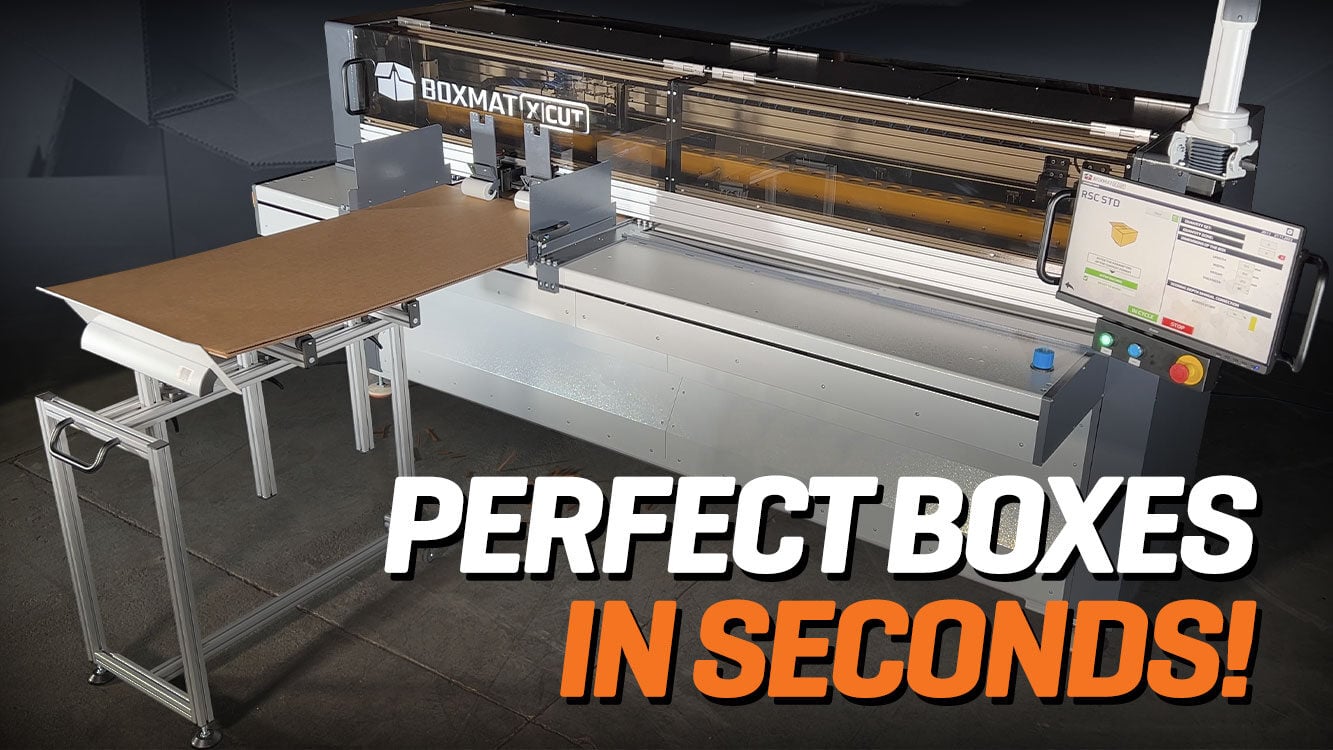
The Boxmat XCUT semi-automatic box maker is designed for short-to-medium production runs where flexibility and fast setup are important, and this kind of setup can be cost-effective and suitable for smaller operations using compact machines in limited floor space.
What High-Volume Production Actually Looks Like
Higher-volume production generally involves longer runs, fewer SKU changes, and greater emphasis on keeping material moving consistently through the packaging process.
An operation may manufacture boxes throughout a shift for a smaller group of established products. Applications can also involve heavier or thicker corrugated materials that place additional demands on the equipment, so these systems are built to operate with sustained material flow and support continuous operation.
In these environments, buyers should look beyond maximum machine speed. Material handling, feeding capacity, operator involvement, quality, and the ability to maintain consistent quality in production all contribute to real-world throughput.
Matching Machine Capability to Where You Sit on the Spectrum
Once you understand your production pattern, you can begin matching it to the appropriate level of automation and capability. Miller Weldmaster's Boxmat systems cover different points along this spectrum rather than fitting into a simple short-run-versus-high-volume split.
Entry-Level Flexibility for Frequent Changeovers
For manufacturers focused on short-to-medium production runs, the Boxmat XCUT semi-automatic box maker provides an entry point into on-demand box production.
Its semi-automatic approach makes it well suited for operations that prioritize flexibility and regularly transition between jobs. Rather than keeping large inventories of finished boxes, manufacturers can produce the dimensions required for current orders to reduce costs and create boxes that perfectly fit what needs to ship.
This can be particularly useful for small and growing manufacturers, distribution environments, and companies with highly variable packaging requirements.
Versatile All-in-One Systems for Mixed Production
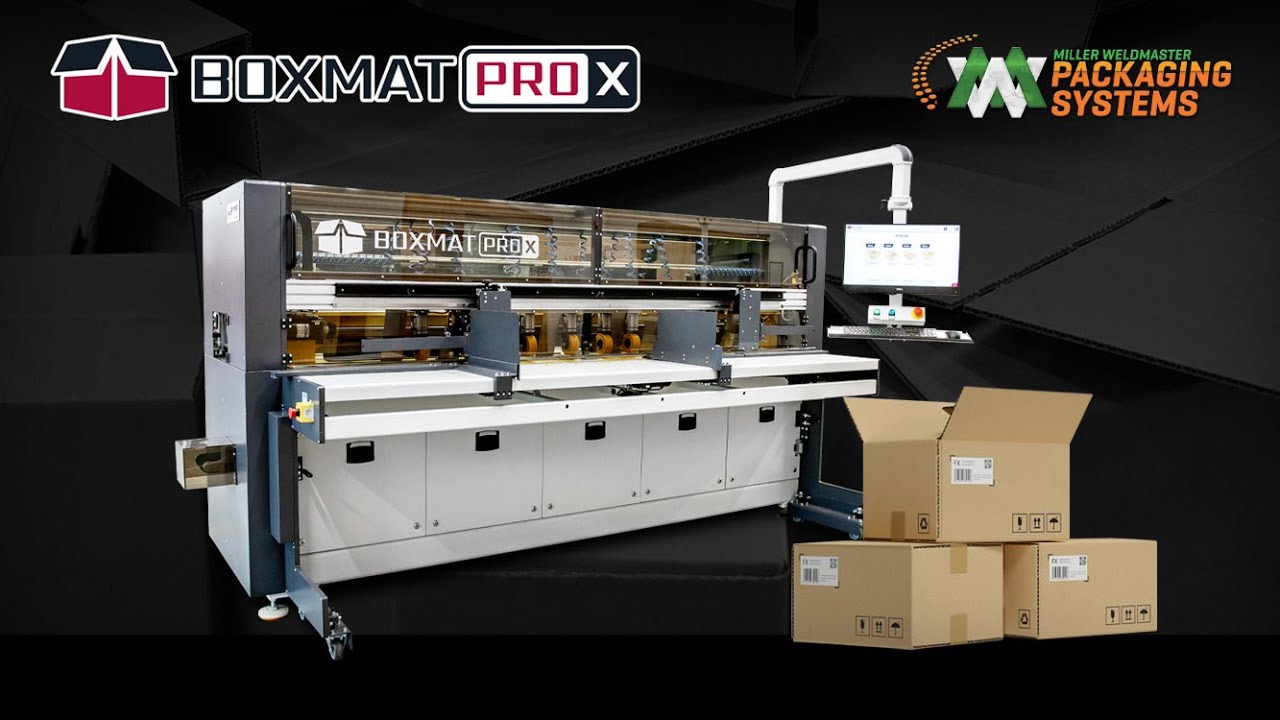
For operations requiring more automation while maintaining flexibility, the Boxmat ProX and Boxmat PROi provide additional capabilities. More advanced box making equipment may also support customized features such as rounded corners and hand holes.
Boxmat ProX's flexible feeding system helps manufacturers handle varying production requirements, and some all-in-one systems use multi-blade cutting to create boxes in multiple sizes more efficiently while supporting efficient box manufacturing.
The Boxmat PROi's serial production capability provides another option for companies balancing changing box requirements with the need for greater production efficiency. Integrated digital printing options can also support branded packaging solutions with high-quality graphics.
These systems occupy the middle of the production spectrum, making them worth considering for companies that have outgrown more manual processes but still require frequent flexibility.
Higher-Throughput, Heavier-Board Production
When applications involve more demanding materials or a greater need for continuous production, the heavy-duty Boxmat HD provides another step along the spectrum. For heavy-duty corrugated box production, that can mean equipment built for higher board strength and more demanding materials.
Its continuous cardboard feeding capabilities and ability to work with single-, double-, and heavy-duty corrugated board make it suited for more demanding production environments.
Some high-capacity systems use 2-Up Production to double output, and certain heavy-duty machines on the market, including the BM3000-HD, are built to process 7-ply AAA heavy duty cardboard.
For manufacturers evaluating this level of equipment, the conversation should extend beyond boxes per hour. Material requirements, run length, feeding demands, and expected future growth should all factor into the decision.
Questions to Ask Before You Buy a Corrugated Box Machine
Before comparing individual machines, take a close look at how your packaging operation actually works.
- How many different box sizes and styles do you produce?
A company producing ten box sizes repeatedly has different needs from one producing dozens or hundreds of configurations. Greater variety generally makes fast setup and flexible programming more valuable. - How often do you realistically change jobs?
Don't base your decision only on peak-day production. Determine how frequently operators move from one box configuration to another during a typical shift or week. - What materials do you need to process?
Consider the board weights, flute types, corrugated materials, and recycled and specialty coated materials you use today as well as materials you may need in the future. - How much floor space is available?
Machine footprint is only part of the equation. Account for space needed to load corrugated material, remove finished boxes, move pallets, and allow operators to work safely. - Do you need additional automation?
Determine whether your process could benefit from features such as inline printing, gluing, or fanfold and vacuum feeder options. Buyers may also want to compare slotting precision, including whether automated systems can hold accuracy within 0.5 millimeters, along with setup flexibility for different width requirements. Consider both immediate needs and capabilities you may want as production grows. - What is your actual average box volume?
Peak production numbers can be misleading. Look at realistic daily and weekly averages, batch sizes, and the amount of variation between orders to determine which machine offers the best fit, especially if you need right-sized packaging built to specific dimensions, which can optimize shipping costs by 15-25%.
The Case for Bringing Box Making In-House
Purchasing a corrugated box machine isn't simply an equipment decision. It can change how a manufacturer manages packaging inventory, production scheduling, and fulfillment.
Producing boxes on demand can reduce the need to stock numerous pre-made sizes. Corrugated sheets or fanfold material can replace rows of finished cardboard box inventory, freeing warehouse space for products, raw materials, or other operations. Custom-sized production can also reduce corrugated material consumption and cut material waste by 20-30%.
In-house production also gives manufacturers greater control over box dimensions. When packaging can be made closer to the actual dimensions of a product, companies can potentially reduce unnecessary packaging material and unused shipping space. Right-sized boxes can improve shipping loads, support cost savings, and reduce the transportation carbon footprint while also helping protect products in transit and support customer satisfaction.
Another benefit is responsiveness. Changes in product dimensions, new customer requirements, seasonal products, and unexpected orders no longer necessarily require waiting for a new shipment of pre-made boxes.
For manufacturers considering the transition, it is important to evaluate the entire packaging process rather than equipment cost alone. Current box purchasing, inventory requirements, labor, storage, shipping efficiency, and lead times should all be part of the calculation. That total-cost view should also account for bottom-line gains from shipping cost optimization of 15-25% and better cash flow from carrying less inventory.
Learn more about how manufacturers can approach custom box solutions for high-volume packaging.
How Miller Weldmaster Supports Both Ends of the Spectrum
Miller Weldmaster offers Boxmat solutions for manufacturers with a wide range of packaging requirements—from businesses introducing on-demand box production to operations moving from startup phases through rapid growth and into broader global markets.
The goal isn't simply to select the machine with the highest published output. It is to identify the equipment that best matches the way your business actually produces boxes.
That means evaluating your box styles, materials, average run sizes, changeover frequency, available labor, floor space, and future production goals. Miller Weldmaster's team can work with manufacturers to evaluate these requirements and determine which Boxmat configuration is suitable for current demand while remaining scalable as production expands.
| Machine | Best Fit on the Spectrum | Notable Capability |
|---|---|---|
| Boxmat XCUT | Short-to-medium runs | Semi-automatic production focused on flexibility and fast setup |
| Boxmat ProX | Short-to-medium and mixed production | Flexible feeding and automated box production |
| Boxmat PROi | Mixed and serial production | Designed to support flexible and serial box manufacturing |
| Boxmat HD | More demanding production | Continuous feeding and capability for heavier corrugated board |
For additional terminology and information about corrugated packaging equipment, visit Miller Weldmaster's packaging glossary.
Ready to determine which corrugated box machine fits your production requirements? Schedule a Boxmat demo and talk with the Miller Weldmaster team about your application.
Frequently Asked Questions About Corrugated Box Machines
What is a corrugated box machine?
A corrugated box machine converts corrugated board into custom-sized boxes by performing processes such as cutting, creasing, and slotting. Depending on the system and configuration, additional finishing and automation capabilities may also be incorporated into the production process.
What's the difference between semi-automatic and fully automatic box machines?
Semi-automatic machines generally require more operator involvement in areas such as material feeding or handling. More automated systems can reduce operator involvement and integrate additional stages of box production, and fully automatic setups may also include folder-gluer or flexo folder gluer functions. These systems can process corrugated blanks in a single pass by printing, creasing, folding, and gluing; flexo folder-gluers print, slot, crease, fold, and glue corrugated blanks in a single pass, while folder-gluer machines fold pre-cut cardboard panels and seal the joint using glue or tape. The best choice depends on production volume, job-change frequency, labor availability, and required flexibility.
How do I choose the right corrugated box machine for my business?
Start with your actual production pattern. Evaluate how often box dimensions change, how many boxes you realistically produce each day, which corrugated materials you use, and how much space you have available. Frequent, variable runs typically place greater importance on fast changeovers, while longer production runs may place more importance on feeding and sustained throughput.
What production volume justifies an in-house box machine?
There is no universal box-count threshold. The decision depends on factors such as your current packaging costs, number of box sizes, inventory requirements, warehouse space, labor, and shipping efficiency. Evaluating the total cost of your current packaging process provides a more useful comparison than volume alone.
How much space does a corrugated box machine require?
Space requirements vary based on the machine and material-handling configuration. Space needs increase further when upstream line components are included, such as a single facer that corrugates the medium with steam-heated fluting rolls and applies adhesive, a glue unit that coats the tips of the single-faced web before it meets the double backer, a double backer that uses heat and pressure to bond the web to the bottom liner, or a cut-off unit that chops the continuous web into precise sheet lengths. When planning a layout, consider not only the machine footprint but also the room required for corrugated material feeding, finished-box handling, operator access, operator training areas, maintenance access, spare parts storage, and other supporting equipment. Added printing modules also affect footprint and workflow, whether a flexographic printing unit is used for logos and labels on flat board or digital printing reaches speeds up to 45 m/min.