
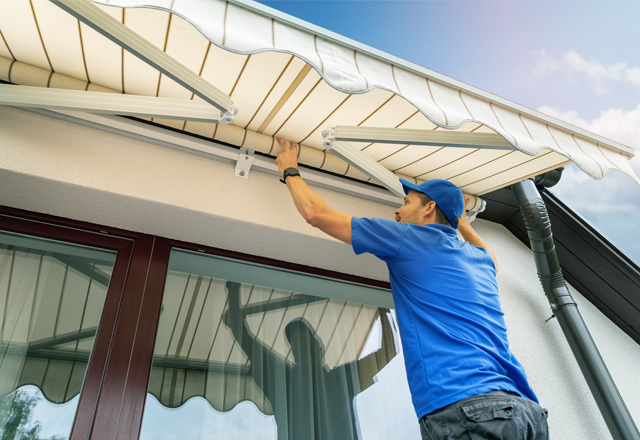
Learning how to weld awning fabric comes down to three things: the right method for your fabric, steady heat, speed, and pressure, and a seam built for the load it will carry. This guide explains how awning welds are made, which welding method fits acrylic, vinyl, and mesh, how to set up the machine, what makes awning seams fail, and how to pick the right equipment.
Awnings typically feature two main components - the frame and the fabric. The frame, generally made of metal, provides the structure for the awning, while the fabric offers a protective covering. This guide covers the fabric. Metal frames are joined with traditional welding, which is a different process.
In deze handleiding:
- Why weld awnings instead of sewing?
- Start with your fabric: acrylic, vinyl, or mesh
- How to weld awning fabric, step by step
- Hot air vs. hot wedge vs. RF for awnings
- Setting heat, speed, and pressure
- Awning seam strength and common failure modes
- Choosing the right machine for your shop
- Best practices and safety
- Veelgestelde vragen
Why Weld Awnings Instead of Sewing?
Welding joins awning fabric with heat and pressure instead of thread. That changes how the seam performs and how it looks:
- Stronger, longer-lasting seams: Welded seams don’t rely on thread, which can wear out, fray, or absorb moisture.
- Watertight seams: Sewing perforates the fabric, and those needle holes can leak over time. A welded seam has no holes to seal.
- A clean, professional look: No visible stitch lines and no thread matching, which helps on striped and multi-color awnings.
- Faster, more consistent production: The machine pulls the fabric through at a set speed, so seams come out the same from operator to operator, with less rework.
- Room to grow: The same machine can join acrylic, vinyl, and PVC-coated awning fabrics, so you can add products without new equipment.
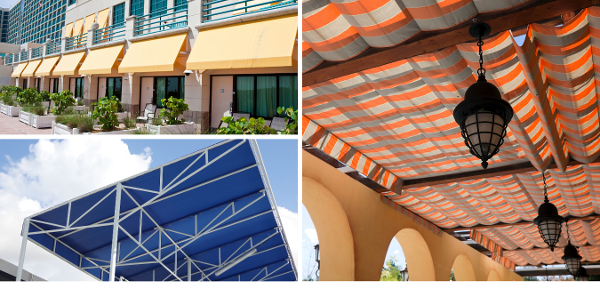
Sewing still has a place for decorative stitching and fabrics that can’t be welded or bonded. For a closer look at leak-proof seams, see seaming vs. sewing for awnings.
Start With Your Fabric: Acrylic, Vinyl, or Mesh
Awning fabrics behave very differently under heat and pressure, and that should drive both your welding method and your settings.
Acryl
Acrylic awning canvas is woven from acrylic fibers and does not melt and re-fuse like vinyl. It is bonded instead: a heat-activated bond tape goes between the two layers, the machine’s heat activates the tape, and the rollers press the seam together. Heat without tape can glaze or scorch the surface without creating a bond. Learn more about acrylic fabric bonding.
Vinyl (PVC-gecoat of gelamineerd)
- A true thermoplastic that melts and re-fuses consistently
- The widest weld window (temperature and speed range)
- Welds well with both hot air and hot wedge, and RF-suitable vinyls can also be RF welded
- A good fit for automated seam production
Learn more about PVC and vinyl welding.
Gaas (PVC-gecoat of anders)
- Lower mass, so it heats up faster than solid fabrics
- The open structure can distort under too much heat or pressure
- Usually needs lower heat and controlled pressure to avoid flattening
How to Weld Awning Fabric, Step by Step
Hot air and hot wedge welders follow the same basic process. The machine controls the temperature and speed, and the right settings will vary based on your material.
- Prepare the fabric. Make sure the surfaces are clean and dry, and cut panels square so the seam runs straight.
- Overlap the panels. Overlap the two pieces of material, or fold the hem. For acrylic, the bond tape goes between the layers.
- Guide the material. Guides help the operator keep the material in position as it moves through the machine.
- Apply heat. Hot air or a heated wedge goes between the layers at the seam, melting both surfaces (or activating the tape).
- Press the seam. Immediately following this, weld rollers press the melted surfaces together. The rollers also pull the material through the machine, so speed and pressure stay steady.
- Test and record. Weld a sample, peel test it, and record the settings so every run matches.
It's crucial to maintain a consistent pressure, temperature and speed to ensure a uniform weld.
Radiofrequentielassen (RF)
RF welding, or dielectric sealing, utilizes electromagnetic energy to generate heat within the molecules of the materials. When the material is placed between two electrodes and exposed to high-frequency waves, the internal heat generated causes the material to melt and bond. It produces clean, consistent seams on RF-suitable vinyls. Proper grounding and safety measures are paramount when using RF welding, as it deals with high-frequency electromagnetic fields.
Wanneer beide technieken correct worden uitgevoerd, resulteren ze in duurzame en waterdichte naden die ideaal zijn voor luifeltoepassingen.
Hot Air vs. Hot Wedge vs. RF for Awnings
Once you know your fabric, choose the method that fits your seams and volume. Hot air welding is the most flexible option for shops with mixed fabrics. Hot wedge welding gives very stable, repeatable seams on long, straight runs. RF and impulse welding suit more specialized work.
| Methode | How it heats | Awning fabrics | Best for |
|---|---|---|---|
| Hete lucht | Heated air between the layers | Vinyl, mesh, acrylic with bond tape | Mixed materials; hems, pockets, and curves as well as straight seams |
| Hete wig | Heated metal wedge between the layers | Vinyl, coated fabrics, acrylic with bond tape | Long, straight seams and repeat production |
| RF | Electromagnetic energy heats the material from the inside | RF-suitable PVC and vinyl | Premium seams where appearance and repeatability justify the cost |
| Impuls | Short, controlled cycles of electrical heat | Acrylic and specialty fabrics | Precise welds where seam appearance matters |
Setting Heat, Speed, and Pressure
These are general starting points, not exact numbers. Always confirm with your fabric supplier and test on scrap before production.
Acrylic (With Bond Tape)
- Heat: Enough to fully activate the tape, without glazing or scorching the canvas
- Speed: Slow to medium, so the tape has time to activate
- Pressure: Moderate, for full contact without crushing the weave
Vinyl (PVC-gecoat of gelamineerd)
- Heat: A broader, more forgiving range within the manufacturer’s recommendations
- Speed: Medium to fast once seam quality is proven
- Pressure: Consistent, for an even seam without thinning the material
Gaas
- Heat: Lower than for solid fabrics
- Speed: Steady
- Pressure: Light and controlled, to avoid flattening the mesh
Always weld small test samples first, do a quick peel test, and record the final settings so you can repeat them.
Awning Seam Strength and Common Failure Modes
Most awning seam problems show up where the fabric carries the most load.
High-Stress Areas
- Kederranden en zakken
- Hoeken en spanningspunten
- Lange zomen aan de voor- en achterkant
- Verbindingspunten met frames en hardware
Veelvoorkomende storingen
- Too much heat: The fabric becomes brittle or discolored, and the seam can crack over time.
- Too little heat: The seam can peel apart under wind load or tension.
- Uneven pressure: One side of the seam bonds more weakly, so the seam can roll or twist.
- Fabric mismatch: Different weights or coatings in the same seam fuse unevenly.
If you see early signs of seam trouble, widen the seam, adjust heat or speed slightly for better fusion, and add reinforcement at corners and ends.
Choosing the Right Machine for Your Shop
Match the machine to your fabrics, seam types, and volume. Miller Weldmaster’s awning welding machines range from portable welders to automated production lines:
- Portable welders: For small shops, on-site repairs, and specialty hems or pockets. The Triad Extreme is a portable hot wedge welder for awnings and shades that works stationary or travels on a track.
- Industrial welders: For daily production, with guides for multiple seam styles and more consistent seams, such as the T300 Extreme.
- Automated systems: For high-volume and multi-shift production, with long, straight seams and automation that reduces material handling, such as the 112 Extreme.
The main cost drivers are the welding method, the working length and table size, the level of automation and controls, and the training and support you need.
Best Practices and Safety
Naadkwaliteit
- Keep fabric surfaces clean and dry
- Zorg voor een constante spanning en uitlijning
- Set and lock in proven weld settings
- Snijd overtollig materiaal netjes weg zonder de las te beschadigen.
- Follow a regular maintenance schedule to prevent downtime
Veiligheidschecklist
- Respecteer hete oppervlakken (sproeiers, wiggen, verwarmingselementen)
- Wear appropriate PPE: gloves, safety glasses, and long sleeves as needed
- Ventilate the area when welding PVC or coated fabrics
- Keep hands clear of pinch points near rollers and drive belts
- Let machines cool down before maintenance
Consistent operator training is often the difference between recurring seam issues and stable, high-quality awning output. Miller Weldmaster trains every new customer on their fabric welding machine, and most are producing products within a few hours.
Not sure which method fits your awning fabrics? Talk to a Miller Weldmaster expert, or send us a sample and we’ll test it on our machines.