Drop stitch welding (also called double-wall fabric welding) is the process of using controlled heat and pressure to bond the outer layers of drop stitch material into airtight, watertight seams — without compressing or melting the internal polyester threads that give the fabric its rigid structure when inflated.
Seam failure. Glue delamination mid-season. Production lines slowing down because operators are trial-and-erroring temperature settings on expensive material. If you're manufacturing inflatable products from drop stitch or double-wall fabric, these are the problems a proper welding process — and the right machine — solve. This guide covers everything you need to know: how the material works, the step-by-step welding process, which method to use, and what to look for when selecting production equipment.
- Double-wall fabric, also called drop stitch fabric, requires specialized welding because internal polyester threads must be preserved — standard heat settings for flat PVC or TPU will compress these threads and compromise the finished product.
- Hot air welding is the most reliable method for double-wall fabric because it allows precise temperature control at the seam, creating a bond as strong as the surrounding material.
- Welded seams significantly outperform glued seams for inflatable applications: adhesive bonds degrade under repeated pressure cycling and UV exposure, while heat-welded seams hold structural integrity across the product's full lifespan.
- An ultrasonic cutter is critical to the process — it cuts and temporarily tacks the top and bottom panels together in one pass, preventing movement and misalignment before the weld begins.
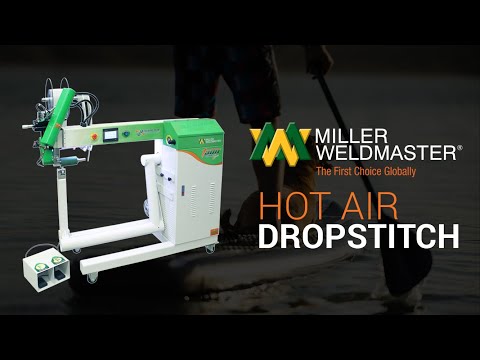
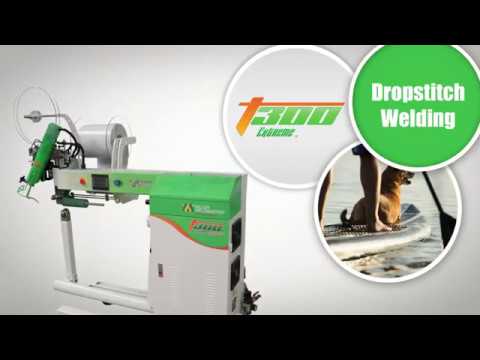
- Miller Weldmaster's T300 Extreme Curve Double-Wall is purpose-built for double-wall and drop stitch welding, with a curved weld arm for complex seam geometries, an included ultrasonic cutter that cuts and tacks the panels, and a touchscreen that stores settings for repeatable, production-scale results.
What Is Double-Wall Fabric?
Before you can weld it correctly, you need to understand what makes double-wall fabric structurally different from every other industrial textile. The construction is unlike anything in standard fabric welding — and that difference drives every decision in the welding process.
Double-Wall Fabric Definition
Double-wall fabric (also called drop stitch fabric or drop stitch material) is a two-layer coated textile in which the top and bottom fabric surfaces are connected internally by thousands of tightly woven vertical polyester threads. When inflated, the threads pull taut, creating a rigid, flat panel that holds its shape under significant air pressure. When deflated, the fabric rolls and folds like standard material.
The ‘drop stitch’ name comes from the manufacturing process: threads are woven (‘dropped’) vertically between the two outer layers at high density; the thread count depends on the application. Drop stitch material is typically built on two base fabric types: warp-knitting and woven. Thread length determines the inflated thickness of the panel — 4-inch drop stitch is common for paddle boards, while 6-inch or thicker drop stitch is used for heavier load-bearing inflatables.
The welding challenge is this: the bonding surface you need to activate is the outer thermoplastic coating (PVC or TPU) on each fabric layer. But those two layers are held apart by the internal thread structure. Too much heat, too much pressure, or the wrong approach, and you compress or melt the threads — destroying the structural integrity of the finished product. The goal is to fuse only the bonding surfaces while leaving the interior completely intact.
Double-Wall vs. Other Materials
Standard single-layer PVC or TPU fabric is a straightforward welding target: one surface on each panel, applied heat, roller pressure, done. Double-wall fabric adds complexity at every step — the internal thread structure means you can’t apply heat through the full thickness, and the geometry of inflatable products means you’re often welding around curves, not straight edges.
Warp-knitting base fabric remains the most widely used on the market across inflatable products, though it tends to have more weight than woven constructions. Woven base fabric is used for luxury inflatable products that need higher stiffness and performance.
| Functie | Standard PVC / TPU Fabric | Double-Wall / Drop Stitch Fabric |
|---|---|---|
| Internal structure | Single-layer — no internal components | Two coated layers connected by thousands of polyester threads |
| Welding method | Standard hot air or hot wedge | Specialized hot air; no through-thickness heat |
| Bonding surface | Full face of each panel | Outer coating layer only — interior threads must not be contacted |
| Inflation pressure range | Not applicable (non-inflatable) | Set by the product type and thread density |
| Typische toepassingen | Tarps, covers, banners, industrial enclosures | SUPs, kayaks, gym mats, military shelters, medical inflatables |
Industries and Applications
Double-wall fabric is specified wherever a manufactured product needs the benefits of being lightweight and easy to transport when deflated, yet able to deliver rigidity and structural stability when inflated. Welded seams — not glued — are the production standard across every one of these sectors because the consequences of seam failure are too high.
- Recreational inflatables (SUPs, kayaks, paddle boards): Seams must withstand continuous pressure cycling, UV exposure, and water contact over the product’s full service life in products valued for being light to carry yet firm in use. A failed seam means a field-returned product.
- Fitness equipment (air tracks, gym mats, gymnastics flooring): High-cycle repeated compression requires seam bonds that match base material strength. Delaminating seams in a gym environment create safety liability.
- Military and tactical inflatables (field shelters, tactical platforms, emergency gear): Tolerances are non-negotiable. Airtight seams must hold under temperature extremes, rough handling, and rapid deployment conditions.
- Water sports and marine (inflatable boats, floating docks, rescue craft): Marine environments accelerate adhesive degradation in boats and other inflatable products that need to stay portable without sacrificing stiffness on the water. Welded seams are the only reliable long-term solution for saltwater-exposed products.
- Medical emergency equipment (patient transport inflatables, evacuation systems): Seam failure in a medical context is a critical safety event. Welded seams with documented parameters and pressure-tested QC are required.
The material you’re working with determines the welding equipment you need. The sections below walk through the process in full.
How Double-Wall Fabric Welding Works
What follows is the workflow used in professional manufacturing environments — from raw material inspection through finished seam verification.
Step 1 — Inspect and Prepare the Double-Wall Fabric
Begin with a full inspection of the fabric panels before any cutting or handling. Check the cut edges for delamination, fraying, or thread pullout from previous processing. Surface contamination is the most common cause of preventable bond failures: oils from handling, release agents left from fabric storage, and surface dust all degrade bond strength — even on otherwise correct machine settings.
Confirm the coating material type before setting any machine parameters. PVC-coated and TPU-coated drop stitch fabrics have different weld windows and require different temperature and speed settings. Welding PVC parameters on TPU material (or vice versa) produces either an insufficient bond or surface damage. If you're working with an unfamiliar roll, confirm the coating with your material supplier before running production.
Cleaning protocol: wipe bonding surfaces with isopropyl alcohol on a lint-free cloth. Allow full solvent evaporation before welding. Do not proceed while any surface moisture or solvent residue remains.
Step 2 — Cut Panels with an Ultrasonic Cutter
An ultrasonic cutter is the correct cutting tool for double-wall fabric. It is not interchangeable with rotary cutters, blade cutters, or scissors for production work. Here is why: ultrasonic welding and cutting use high-frequency vibrations to melt and fuse the material at the cut line, sealing the raw edge as it cuts. This prevents fraying of the outer coating and, critically, seals the exposed thread ends at the cut line.
Standard blade or rotary cutters leave open thread ends at the cut edge. Under welding heat and roller pressure, these exposed threads can pull back from the seam edge or create voids in the bond line. The result is a seam that looks acceptable visually but has compromised edge integrity under pressure.
Cut panels to pattern with clean, straight lines, using precise patterns as your guide. Precision at this step directly affects seam alignment in every subsequent step. A cut that’s even slightly off pattern produces an alignment error that compounds through the weld pass.
Step 3 — Align Top and Bottom Panels (Fiber Matching)
This step is unique to double-wall fabric and is the most common source of structural failures in first-time double-wall manufacturing operations. The internal threads of the top panel and bottom panel must be aligned before welding.
When the internal threads of both panels run in the same direction, the inflated product holds a flat, uniform geometry. When threads are misaligned — even slightly — the inflated product twists, bows, or develops a warp that cannot be corrected after manufacture. This is not a cosmetic issue: structural asymmetry concentrates stress at specific seam points, accelerating failure under pressure cycling.
Alignment check procedure: face the panels with coated sides in toward the seam (bonding surfaces together), confirm that the thread pattern direction matches on both layers, mark clear panel patterns with chalk or marking pen as alignment guides for cutting and matching, and clamp the assembly into position. The ultrasonic cutter performs the tacking function in this step, running a low-energy pass that temporarily bonds the outer edges of the two panels without applying full weld heat — locking their relative position before the main weld pass begins.
Step 4 — Configure Seam Type and Machine Settings
Seam type selection is determined by the seam’s function in the finished product.
Temperature and speed settings depend on coating type and material thickness and product sizes. PVC-coated drop stitch typically welds at higher nozzle temperatures than TPU. Start every new material run with a test strip on scrap material. Verify the weld window — the temperature range that produces a clean bond without thread compression — before committing to production. The T300 Extreme Curve’s PLC interface stores named recipes per product, so verified parameters are recalled accurately on every subsequent run.
Step 5 — Weld the Sidewall
The sidewall weld is the most technically demanding seam in a drop stitch product. The sidewall must wrap around the full curved perimeter of the top and bottom panels, maintaining consistent seam width, overlap, and heat distribution throughout the pass.
This is where straight-arm welders fail for inflatable applications. A straight weld arm cannot navigate a curved seam geometry without operator intervention — manual repositioning around each curve introduces speed variation, and speed variation directly changes the effective heat input per unit length of seam. Inconsistent heat produces inconsistent bond strength. On a production paddle board, that means variable seam performance across the same product.
A curved weld arm, like the design on the T300 Extreme Curve, maintains continuous contact with the seam geometry throughout the full sidewall pass. The operator feeds the material; the machine handles the geometry. Production throughput for sidewall welding on a properly set-up T300 runs continuously without manual repositioning stops, which directly impacts units-per-shift output.
Step 6 — Inspect and Pressure Test the Finished Seam
Visual inspection first: check for uniform seam width along the full seam length, no edge lifting at the seam margins, no bubbling or discoloration on the welded surface, and consistent roller track marks indicating even pressure throughout the pass.
Pressure test after visual pass: inflate the finished product to rated PSI and hold for a defined period. Mark any area showing pressure loss and trace back to the seam location. Seam failures that show up in pressure testing are significantly cheaper to rework before final finishing operations than after.
Document your rejection criteria before production begins. Define the minimum acceptable seam width, the maximum permitted edge lift, and the hold-time pressure loss threshold. Consistent QC standards reduce field returns and build institutional process knowledge across your production team.
Double-Wall Fabric Welding Methods — Which One Is Right for Your Application?
Three welding technologies are relevant to double-wall fabric manufacturing: hot air welding, hot wedge welding, and ultrasonic welding. Understanding where each one works — and where it doesn't — prevents expensive equipment mismatches.
Hot Air Welding — Why It's the Standard for Drop Stitch
Hot air welding directs precisely heated air into the seam area, softening the thermoplastic coating on both fabric layers just enough to bond them under roller pressure. No physical element contacts the bonding surface directly — the heat is conveyed by airflow, which gives the operator a controllable, adjustable heat window.
For double-wall fabric, this is the critical advantage. Because the heat is applied via airflow rather than direct contact, operators can dial in a narrow temperature band that activates only the outer bonding layer. The internal thread structure never reaches melt temperature. The result: a full-strength surface bond with zero thread compression.
Nozzle temperature, roller pressure and feed speed for drop stitch fabric are calibrated to material thickness and coating type. These parameters vary by material — always confirm on test strips before production.
Hot Wedge Welding — When It's Useful for Straight Seams
Hot wedge welding inserts a heated metal element between the two fabric surfaces, generating the bond temperature through direct conduction contact. For straight, high-volume seam runs on flat material — banner stock, tarpaulins, long panel joints — it is highly efficient and consistent.
The limitation for inflatable work is geometry. A hot wedge cannot navigate the curved sidewall seam profile of a paddle board, kayak, or inflatable boat without manual repositioning. For products where all seams are straight and the material is single-layer, hot wedge remains a strong choice. For double-wall inflatable manufacturing, it is not the primary tool.
Ultrasonic Welding — Limited Role in Double-Wall Applications
Ultrasonic welding uses high-frequency mechanical vibration to generate friction heat at the bonding interface. It works well for thin, uniform materials and is commonly used for medical packaging and nonwoven fabrics. Its role in double-wall fabric manufacturing is specific and limited: cut-and-tack operations.
The high-frequency vibration approach that produces clean bonds on thin single-layer PVC cannot effectively deliver energy through the layered structure of drop stitch material for a full structural seam. Ultrasonic welding is a supporting tool in the double-wall workflow, not the primary welding method.
Welding vs. Gluing Double-Wall Fabric — A Direct Comparison
The question of welding vs. gluing for inflatable products comes up consistently in manufacturing evaluations. The answer is not nuanced: for production-quality double-wall inflatables, welding is the industry standard.
The adhesive approach survives in prototype and very low-volume work where machine investment isn’t justified. At any meaningful production scale, the math favors welding on every dimension: speed, consistency, per-unit cost, and product longevity. The field return rate alone on glued inflatables is enough to reverse the apparent cost advantage of the adhesive approach.
The comparison table below shows why.
| Factor | Lijmen | Hete lucht lassen |
|---|---|---|
| Naadsterkte | Variable — depends on adhesive type, surface prep, and cure time | Consistent — a high-quality weld is often stronger than the base fabric itself, producing a durable bonded seam |
| Productiesnelheid | Slow — requires dry time, repositioning, manual labor per seam | Fast — continuous weld at production speed with automated roller |
| Airtight reliability | Risk of micro-gaps, especially at seam edges and corners | Air- and watertight seam when parameters are correctly set |
| Durability under pressure cycling | Adhesive can delaminate over time with repeated inflation/deflation | No delamination risk — bond is a fusion of base materials |
| UV / environmental resistance | Adhesives degrade with UV exposure and temperature extremes | Welded seam inherits the material’s full UV and weather resistance |
| Operator skill required | High — adhesive application is technique-sensitive and hard to standardize | Moderate — parameterized by machine; repeatable with trained operator |
| Long-term cost per unit | Higher — adhesive cost, rework rate, and field failure returns add up | Lower at scale — machine investment pays back through reduced per-unit seam cost |
PVC vs. TPU for Double-Wall Fabric Welding — What You Need to Know
Not all drop stitch fabric is the same. The outer coating — PVC (polyvinyl chloride) or TPU (thermoplastic polyurethane) — determines your welding parameters and, in some cases, your equipment requirements. Getting this wrong is one of the most common causes of production scrap when switching between material suppliers or product lines.
PVC-Coated Drop Stitch
PVC (polyvinyl chloride) is the most widely used coating for drop stitch fabric. It is cost-effective, widely available globally, and responds predictably to hot air welding with established parameters. For most recreational inflatable manufacturers — paddle boards, kayaks, consumer gym mats, inflatable boats in the value segment — PVC-coated drop stitch is the standard material.
Welding PVC typically requires higher nozzle temperatures than TPU. The weld window is relatively forgiving compared to TPU, which makes it easier to train new operators on. Limitation: PVC stiffens in cold temperatures, which affects performance in products deployed in cold climates, and it is not suitable for applications requiring food contact or regulatory compliance in medical contexts.
TPU-Coated Drop Stitch
TPU (thermoplastic polyurethane) is the premium coating option. It is lighter than PVC for equivalent thickness, significantly more flexible across a wide temperature range, and more resistant to abrasion and hydrolysis. Products that need to perform reliably in cold environments, resist chemical exposure, or meet medical-grade material requirements are typically built from TPU-coated drop stitch.
Welding TPU requires different parameters than PVC: typically lower nozzle temperatures with higher roller pressure to achieve the correct bond without surface burn. The weld window is narrower, which makes operator training more important. The T300 Extreme Curve accommodates both PVC and TPU through its PLC parameter storage — operators select the product recipe and the machine recalls the verified settings, eliminating manual parameter adjustment between runs.
If your production line handles both coating types across different product lines, machine flexibility and recipe management capability are non-negotiable requirements in your equipment selection.
What to Look for in a Drop Stitch Welding Machine
This section is for buyers who have confirmed they need a dedicated double-wall welding solution and are now evaluating equipment. The decision criteria below are derived from the technical requirements of the welding process — not marketing language.
Curved Weld Arm for Sidewall Geometry
The sidewall seam on an inflatable product follows a curved profile. A weld arm that cannot match this geometry forces the operator to manually reposition the material through each curve — introducing speed variation, which translates directly into variable heat input and inconsistent bond strength.
A purpose-built curved weld arm is the single most important hardware distinction for inflatable manufacturers. It enables continuous, uninterrupted welding around the full product circumference without operator intervention. For paddle boards and kayaks specifically, where the sidewall seam is the longest and most structurally critical seam on the product, this capability is not optional.
Hot Air and Hot Wedge Heat Systems
Drop stitch seams are welded with hot air: heated air softens the coating on both panels just before the rollers press them together, so no heated part touches the fabric. The machine's specifications also list a hot wedge heat system for seams where a heated wedge works better.
Hot air reaches up to 730°C (1,346°F) and hot wedge up to 450°C (842°F), with welding speeds up to 30 m/min (100 ft/min) depending on the material and seam width. Settings for each material are stored on the touchscreen, so a verified weld can be repeated on every run.
Integrated Ultrasonic Cutting and Tacking
A machine that combines the cut-and-tack operation with the welding workflow eliminates a manual panel-handling step between cutting and welding. The ultrasonic cutter performs two functions in a single pass: it cuts the panel edge clean (sealing exposed thread ends in the same operation) and applies a low-energy tack bond that locks the top and bottom panels in aligned position before the main weld pass.
Without this integration, panels require external clamping and manual re-checking of thread alignment before welding. Any panel shift between clamping and weld start produces a misaligned seam. Integrated cut-and-tack removes this variable entirely.
PLC / HMI Parameter Control and Recipe Storage
PLC (programmable logic controller) and HMI (human-machine interface) parameter control is a production necessity, not a premium feature, for double-wall welding. Temperature, speed, and roller pressure interact — a change in one parameter requires compensation in the others. Manual adjustment between product runs introduces operator error and generates scrap material during the setup period.
A PLC-equipped machine stores named parameter recipes per product type: select 'PVC SUP Sidewall — 4 inch' from the touchscreen interface and the machine recalls the verified settings. New operators produce quality seams on the first production run. Experienced operators maintain consistency across shifts without manual re-calibration. At any production volume above prototyping, recipe storage pays for itself in reduced scrap and faster changeover.
On-Site Installation, Training, and Long-Term Support
Double-wall fabric welding is a specialized process. A welder sitting idle because the team can’t resolve a bond consistency problem costs more per day than the installation fee for a certified field service engineer to set the machine up correctly, and ongoing support for customers after installation and training helps keep production on track. Machine vendors who provide on-site installation, documented operator training, and accessible long-term service support materially reduce the time from machine delivery to production-quality output.
A Miller Weldmaster certified field service engineer installs the T300 Extreme Curve Double-Wall at your facility and trains your staff on operating and maintaining it and on producing your product. After installation, help is available by phone, through virtual troubleshooting and from traveling technicians.
Miller Weldmaster’s T300 Extreme Curve Double-Wall is engineered specifically for double-wall and drop stitch fabric. See the T300 Extreme Curve Double-Wall specifications.
Common Double-Wall Fabric Welding Mistakes — and How to Avoid Them
These are the errors that show up in production environments where the team is experienced with standard PVC welding but new to double-wall material. All five are preventable with the right process knowledge.
Mistake 1 — Using Standard Welding Parameters from Flat PVC Work
The most common error when transitioning to double-wall fabric: operators carry over temperature and speed settings from their single-layer PVC work. The results are predictable. Too low: insufficient bond strength, seams that peel under pressure testing. Too high: thread compression, surface scorching, a product that fails structurally when inflated.
The correction is straightforward: treat every new material as an unknown and run a test strip sequence. Start in the middle of the estimated weld window for the coating type, weld a short test strip, peel-test the bond, and adjust up or down. Document the verified settings and lock them into the machine's recipe storage before the first production run begins.
Mistake 2 — Skipping the Ultrasonic Tacking Step
Some operators attempt to weld double-wall panels without tacking first, using clamps or manual holding to maintain alignment. This is workable for very short test welds. It fails at production pace.
Panel movement during a weld pass produces misaligned seams, offset thread rows, and visual edge irregularities that require rework. On a finished paddle board, a seam with uneven overlap is not a cosmetic issue — it's a structural inconsistency that concentrates stress at the overlap edge under inflation pressure. The ultrasonic tacking step is not optional for consistent production quality.
Mistake 3 — Misaligning the Internal Thread Structure
When the top and bottom panel threads don’t run parallel before welding, the inflated product doesn’t lie flat. It twists. It bows. It can lose its intended form and develop a structural warp that cannot be corrected after the seam is set. This is particularly visible in paddle boards and gym mats, where surface flatness is a direct product quality indicator.
The alignment check — threads parallel, pattern marked, panels clamped — must happen before every tack-and-weld pass, not just the first one of the production run. Thread orientation is the foundation of every quality characteristic in the finished product.
Mistake 4 — Welding Contaminated Fabric
Oils from handling, release agents from fabric storage, and surface particulates all produce bond failures — even when machine parameters are correct. A contaminated area in a seam acts as a release layer, preventing full thermoplastic fusion. The bond looks acceptable visually but fails at the contamination point under inflation pressure.
Pre-weld cleaning is non-negotiable on production lines where human handling is part of the workflow. Isopropyl alcohol wipe, full evaporation, no contact with bare hands on bonding surfaces after cleaning. This adds a few minutes per panel pair and prevents the rework and field returns that a contaminated seam generates.
Mistake 5 — Choosing a Straight-Arm Welder for Curved Seam Applications
A straight-arm welder on a curved sidewall seam means the operator is manually steering the material through the curve. Each manual adjustment changes the feed speed. Feed speed changes the effective heat per unit seam length. Variable heat produces variable bond strength — a seam that tests fine on the straight sections and has weaker zones at every curve transition.
If your product has curved seams — and every inflatable SUP, kayak, and inflatable boat does — a straight-arm welder is the wrong tool. The machine architecture is the constraint, not operator skill. A curved-arm welder removes this variable from the equation entirely.
Kies Miller Weldmaster al uw behoeften op het gebied van heteluchtlasapparatuur
Miller Weldmaster builds hot air welders for drop stitch fabric, including the T300 Extreme Curve Double-Wall with its ultrasonic cutter, used to make paddle boards, kayaks, inflatable boats, gym mats and evacuation slides. Choosing the right setup starts with your product and your production volume.
How To Get Started with Miller Weldmaster:
Step 1: Define Your Requirements
Bepaal uw materiaalbehoeften en benodigde productievolumes met deskundige begeleiding Miller Weldmaster.
Step 2: Evaluate Your Workspace
Laat Miller Weldmaster van Miller Weldmaster de beperkingen van uw werkruimte en de voordelen van automatisering voor uw specifieke toepassing beoordelen.
Step 3: Connect with an Expert
Neem contact op met de Miller Weldmaster om de specifieke mogelijkheden van de machines te bespreken, demonstraties aan te vragen en persoonlijke ondersteuning te krijgen om uw lasproces te optimaliseren.
Als uw stof er niet bij staat, neem dan contact met ons op en vertel ons wat u nodig hebt voor het lassen van stoffen.